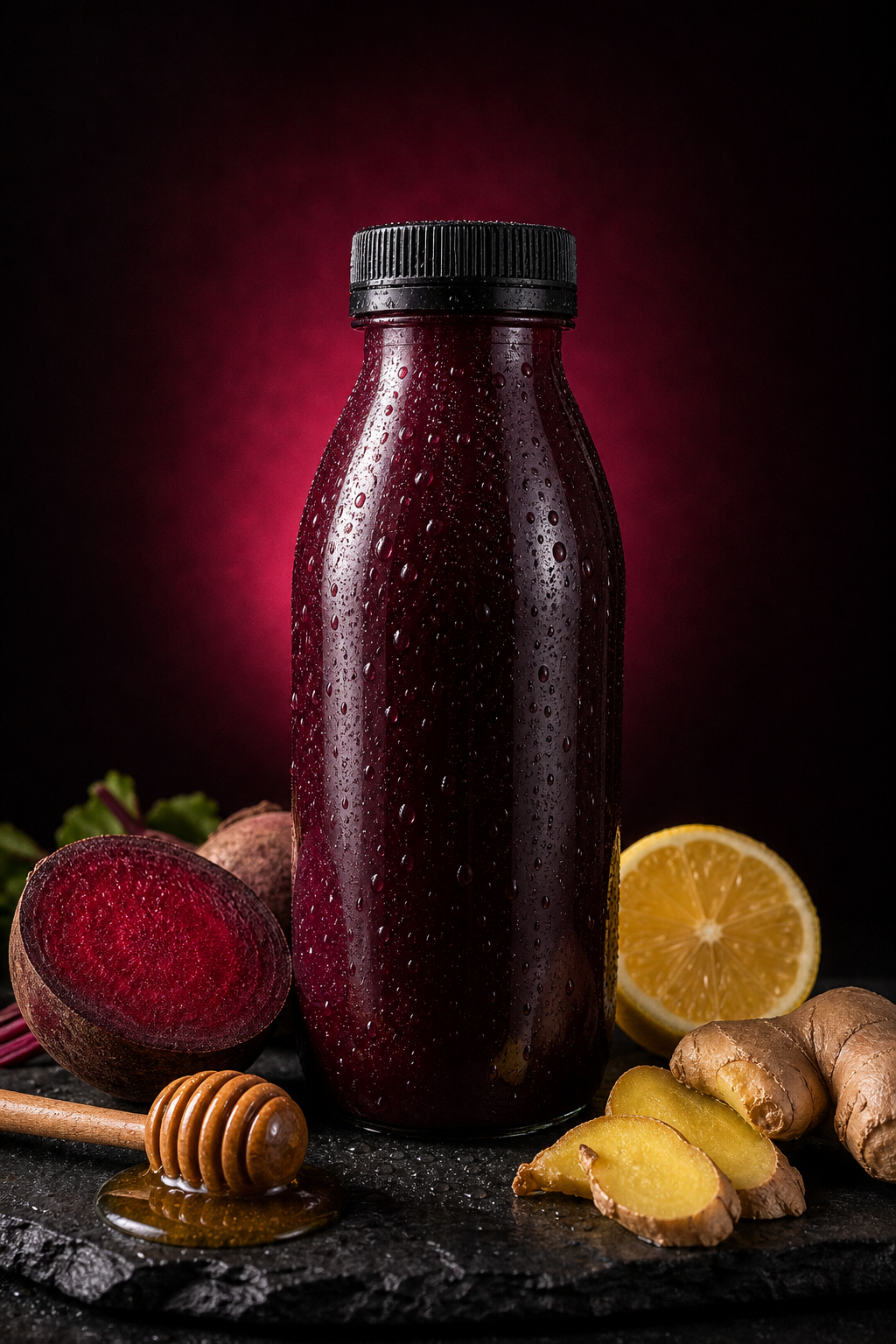
Why Beetroot? The Nitric Oxide Mechanism
Beetroot is one of the most nitrate-dense vegetables consumed by humans. Dietary nitrates convert to nitric oxide (NO) in the body via a two-step reduction pathway — nitrate to nitrite in the mouth, and nitrite to NO in acidic environments like the stomach and exercising muscle tissue.
Nitric oxide is a vasodilator. When it's produced in sufficient quantities and frequency, blood vessels relax, widen, and allow more blood — and therefore more oxygen and nutrients — to reach muscle tissue. This is the mechanism at the core of the Beetroid formula.
Key Numbers from the Data
40–60% increase in blood flow. 13% improvement in muscle power output. 500+ documented views on blood pressure reduction alone. These aren't aspirational — they come from aggregated content referencing peer-reviewed studies.
Week 1: Days 1–7
What you might notice: A distinct red tinge in urine and stools. This is beturia — completely normal, caused by betalain pigments passing through the system. First-timers are occasionally alarmed. Don't be.
During week one, the body is establishing steady-state nitrate levels. Most people report subtle changes in workout endurance — slightly less breathlessness in the final sets, marginally more energy during afternoon activity. The changes are real but not dramatic yet.
Week 2: Days 8–14
What you might notice: More consistent energy levels. Reduced muscle soreness after sessions. If you're tracking, this is when your rest heart rate may begin to register lower.
Nitric oxide production becomes more predictable. The body's nitrate-reducing bacteria in the mouth and gut become more active with daily dietary nitrate — the process becomes more efficient. Cardiovascular output per same-effort increases.
Week 3: Days 15–21
What you might notice: Measurable performance improvements if you train. Many people report personal bests during this window — primarily in endurance-dependent activities (running, cycling, swimming) where oxygenation matters most.
Blood pressure, for those with hypertension, often shows measurable reduction by week 3. The vasodilation effect on peripheral blood vessels becomes more consistent throughout the day rather than just post-consumption.
Week 4: Days 22–30
What you might notice: The full picture. Sustained energy, reduced recovery time, continued cardiovascular adaptation. The cumulative effect of 30 days of daily nitric oxide production.
This is also where the antioxidant effect of betalains becomes meaningful — free radical reduction accumulates over time. Cellular protection compounds over 30 days in a way it can't from a single dose.
The Protocol That Works
Drink Beetroid 30–45 minutes before training for peak performance windows. For daily health support, consume in the morning fasted. Don't consume mouthwash immediately beforehand — the mouth bacteria that convert nitrate to nitrite are disrupted by antibacterial products.
Why Cold-Pressed Matters for Beetroot
Heat destroys nitrate-reducing enzymes. Pasteurised beetroot juice loses a significant portion of its nitric oxide conversion capacity. Cold-pressing preserves the full enzymatic profile — and ozonated water cleaning ensures the produce is pathogen-free before it's ever processed.
This is why Beetroid is cold-pressed, not blended. And why we clean with ozonated water — not chlorine, which leaves residue that can interfere with the very bacteria responsible for nitrate conversion in the mouth.
The Ingredients in Beetroid
Beetroid isn't just beetroot. The formula includes ginger (doubles as an anti-inflammatory amplifier), lemon (vitamin C protects NO bioavailability from oxidation), and honey (palatability and gut protection). Each ingredient earns its place by supporting the core mechanism — not by adding flavour noise.